

How Do I Get Temporary or Permanent Residency in Mexico?
A step-by-step guide to choosing your residency status, applying through a Mexican consulate, completing the process in Playa del Carmen and keeping your status current.
 Reviewed for Accuracy
 Last Verified: October 25, 2026
 No Login. Just Answers.
 Quick Answer
If you want to live in Mexico longer than a typical visitor stay, you may qualify for temporary or permanent residency.
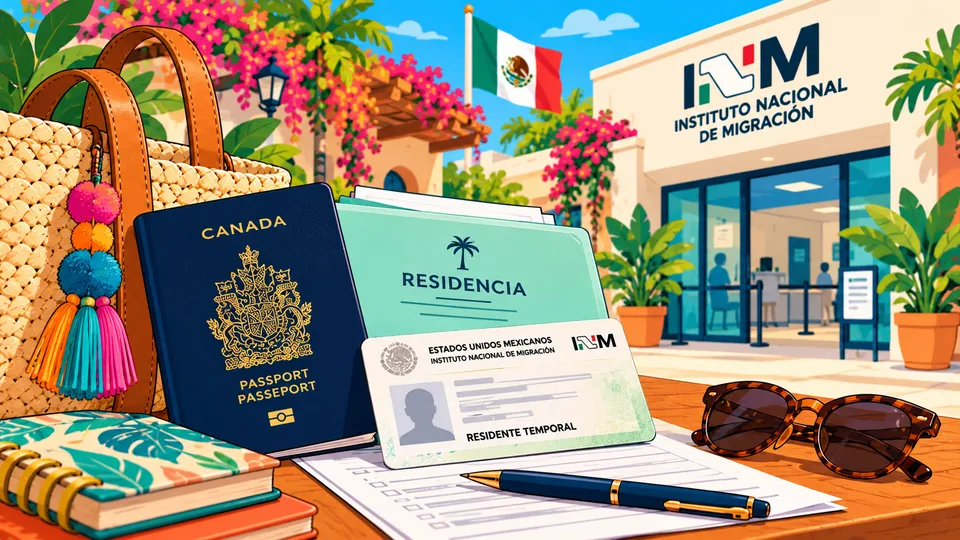
For many first-time applicants, the process begins at a Mexican consulate outside Mexico. If you're approved, you get a residency visa in your passport. After you enter Mexico, you have 30 calendar days to complete the process with the Instituto Nacional de Migración (INM) and get your resident card.
Temporary residency is for stays of more than 180 days and up to four years. Permanent residency lets you live in Mexico indefinitely, but fewer routes qualify for it.
You may qualify through financial solvency, family ties or another authorized route.
The important distinction: a residency visa and a resident card are not the same thing.
Temporary vs. Permanent Residency
Permanent residency isn't citizenship. Permanent residents don't get Mexican voting rights.
You don't always need four years of temporary residency first. Some people, such as qualifying pensioners and some family members, can apply for permanent residency directly.
Which Residency Path Is Right for Me?
- I want to move to Playa and support myself
- You may qualify through financial solvency (solvencia económica). The consulate where you apply tells you which income, pension or savings evidence it accepts.
- I'm retired or receive a pension
- Depending on your circumstances, you may qualify for temporary or permanent residency. Calling yourself retired doesn't guarantee permanent residency: you still have to meet the requirements.
- My spouse or close family member is Mexican or a Mexican resident
- Family ties (unidad familiar) may give you a route. Requirements depend on the relationship and the family member's status. A spouse or partner usually starts with temporary residency.
- I have a job offer from a Mexican employer
- Employer-sponsored residency is a different process: the employer first asks INM for authorization. A tourist entry or residency based on your own finances doesn't by itself let you work for a Mexican employer.
- I already have temporary residency
- You may be able to renew it, or change to permanent residency if you qualify.
Step by Step: Applying From Outside Mexico
- 1. Choose your qualifying route
- Work out the legal basis for your application. Common routes include financial solvency and family ties. Owning property in Mexico is a listed route at consulates, with its own requirements, but buying a home doesn't guarantee residency.
- 2. Choose a Mexican consulate
- Read the requirements published by the consulate where you plan to apply. Financial amounts, document formats, appointment systems and accepted evidence can differ between consulates, so confirm them with that office.
- 3. Gather your documents
- Depending on your route, you may need your valid passport, the visa application form, a passport photo, proof that you're legally in the country where you apply, financial statements or pension documents, family relationship documents, your appointment confirmation and the fee. Some routes need translations, apostilles or other formalities. This isn't a complete checklist for every route.
- 4. Attend your consulate appointment
- The consulate reviews your documents and eligibility, and you may be interviewed. Approval isn't automatic.
- 5. Receive your visa
- If you're approved, the consulate puts a residency visa in your passport. You use it to enter Mexico and start the resident-card process. The visa's entry period isn't the length of the residency you'll be granted.
- 6. Enter Mexico with your residency visa
- At immigration, say clearly that you're entering to complete your residency process, and check that your entry document reflects it. Don't enter as an ordinary tourist and assume the residency process starts by itself.
- 7. Complete the canje with INM
- The “canje” — “exchange” (KAHN‑heh) swaps your visa for a resident card. Within 30 calendar days of entering, book an INM appointment online, fill in the required form, pay the government fees and attend your appointment at the INM office.
- 8. Receive your resident card
- When your card is issued, check your name, immigration status and validity dates right away. Keep it safe, and know when it expires.
What Is an Apostille?
An apostille (called an “apostilla” in Spanish) is an official certificate that authenticates a public document, such as a birth or marriage certificate. It confirms the signature, the official's role and any seal on the document. It doesn't confirm that what the document says is true. Spanish pronunciation: “apostilla” — “apostille” (ah‑pohs‑TEE‑yah).
When you might need one: some residency routes use documents from another country, such as a marriage or birth certificate for a family-ties application. The consulate or INM tells you whether a document needs an apostille. Not every application does.
It isn't a translation. If a document isn't in Spanish, ask the consulate or INM whether you also need a translation and who can do it.
Where to get one: from the competent authority in the jurisdiction where the document originated, not from Mexico. In the US and Canada, that's often a state or province office, depending on who issued or notarized the document. Mexico, the US and Canada are all part of the Hague Apostille Convention; Canada joined on January 11, 2024.
What Is Canje?
In Playa del Carmen, the federal immigration office is on the Explore Playa map. INM's help line in Mexico is 800 00 462 64.
- INM: book an appointment online (Spanish)
- INM: the 18 procedures that need an appointment (Spanish)
- INM: questions about getting your card by canje (Spanish)
Canje = exchanging your visa for a resident card
The consulate approves your visa. INM, Mexico's immigration authority, completes the process and issues your resident card. You have 30 calendar days from your entry to get the card.
INM handles the canje by online appointment only. When the card is issued, INM takes your fingerprints, photos and signature.
The number of visits and how long it takes can vary. Don't plan around same-day processing.
What Are the Financial Requirements?
Financial solvency (solvencia económica) means showing you can support yourself in Mexico. Depending on the residency type and the consulate's rules, you may show it with regular income, pension payments, or savings and investments.
There's no single amount that applies everywhere. The requirements are set in Mexican legal units and converted into local currency, they can change every year, and consulates may ask for different documents. Check the current requirements on the website of the consulate where you'll apply.
How Much Does Residency Cost?
The total cost has separate parts:
- The consular visa fee.
- INM's government fees for the procedure and the card.
- Lawyer or facilitator fees, if you choose to hire one.
- Document, translation, apostille and travel costs.
Check fees on the official page
Government fees change, and the amount depends on the procedure and how long your card is valid for. Check INM's official fee page before you pay, and be careful with amounts quoted on old pages.
Do I Need an Immigration Lawyer?
No rule requires every applicant to hire an immigration lawyer, and many people handle the process themselves.
Professional help may be useful when:
- Your qualifying route is complicated.
- Your documents need special handling.
- Your family circumstances are unusual.
- Your residency has expired.
- An application was denied.
- You have questions about working.
- You're changing your immigration status.
Lawyer or facilitator?
An immigration lawyer and an administrative facilitator (gestor) may offer different services. Ask for their fee separately from the government fees.
Never pay unofficial fees to government employees. Government fees are paid through official channels, with a receipt.
Renewing Temporary Residency
Keep an eye on your card's expiration date. The first temporary resident card you get through canje is valid for one year from your entry, and renewal is a separate INM procedure that needs an online appointment.
Renewal requirements, timing and how long the new card lasts depend on the current rules. Check INM's requirements well before your card expires. An expired card isn't harmless, so don't wait.
Changing From Temporary to Permanent Residency
INM says you can apply to change to permanent residency after four years in a row as a temporary resident. Some people can change sooner, for example pensioners with income from abroad, people with qualifying family ties, or through Mexico's points system.
The change isn't automatic. You have to meet the requirements of your route and apply to INM, with an appointment.
Can I Work in Mexico With Residency?
It depends on your status and the kind of work.
Under Mexico's Migration Law, permanent residency includes permission to work for pay in Mexico. Temporary residents can get a work permit linked to a job offer, and the permit covers that job.
Remote work paid from abroad and a job with a Mexican employer aren't the same situation. SRE says that if you'll be paid in Mexico, the employer must get authorization from INM first. Check what applies to you before you start working.
Can I Travel While My Residency Is Being Processed?
- Before you enter Mexico with your visa
- Check the visa's entry period, so you enter Mexico in time.
- While your canje or another INM procedure is pending
- If you need to leave Mexico, ask INM whether you need a permit to leave and return (permiso para salir y regresar) first. An application receipt alone doesn't always let you travel.
- After you get your resident card
- You travel with your passport and your valid resident card.
What If My Card Expires or I Lose It?
Renewal, replacement and regularization are different INM procedures.
A lost card doesn't necessarily mean your immigration status has ended. Replacing an immigration document is its own INM procedure, with an appointment.
An expired card can create different legal problems. Contact INM promptly, and don't assume you can fix every case by leaving Mexico and coming back.
What Should I Do After I Get Residency?
0 of 6 done
Residency doesn't automatically give you an RFC, make you a tax resident or qualify you for every government program.
Your ticks are saved on this device only.
What Are CURP and RFC?
- CURP: Clave Única de Registro de Población
- The CURP (Unique Population Registry Code) is an 18-character identity code used across Mexico's government systems. Mexico's CURP rules say a resident is assigned a CURP when INM issues their resident card, and the card should show it; if yours doesn't, ask INM. A CURP is an identification code, not independent proof of your current immigration status: your valid resident card is. You can look up and print your CURP for free on gob.mx.
- RFC: Registro Federal de Contribuyentes
- The RFC (Federal Taxpayer Registry) is Mexico's tax ID, issued by the SAT, Mexico's tax authority. The SAT's registration page lists an appointment at a SAT office, which you can start online with a pre-registration, and foreigners bring a valid immigration document; check the SAT for the current options for your situation. Not every resident needs an RFC. Having an RFC doesn't, by itself, determine whether you're a Mexican tax resident or owe Mexican taxes: tax residency follows separate rules, such as where your home is. Ask a tax professional about your own situation.
Common Mistakes to Avoid
- Assuming a tourist entry turns into residency by itself.
- Applying at a consulate without checking its own requirements.
- Confusing the visa with the resident card.
- Missing the 30-day canje deadline.
- Assuming buying property guarantees residency.
- Assuming temporary residency lets you do any kind of work.
- Waiting until your card expires to look into renewal.
- Thinking permanent residency is the same as Mexican citizenship.
- Traveling during an INM procedure without checking the requirements.
Ask Playa Tip
Start checking your residency options before you move. For many people, the process has to begin at a Mexican consulate outside Mexico.
And once you enter with your residency visa, don't miss the 30-day deadline to complete your resident card with INM.
Useful Spanish
Quiero solicitar la residencia temporal.
KYEH-roh soh-lee-see-TAR lah reh-see-DEHN-syah tehm-poh-RAHL
I want to apply for temporary residency.
Tengo una cita en Migración.
TEHN-goh OO-nah SEE-tah ehn mee-grah-SYOHN
I have an appointment at Immigration.
Necesito hacer el canje de mi visa.
neh-seh-SEE-toh ah-SEHR ehl KAHN-heh deh mee BEE-sah
I need to exchange my visa for a resident card.
¿Qué documentos necesito?
keh doh-koo-MEHN-tohs neh-seh-SEE-toh
What documents do I need?
¿Cuánto cuesta el trámite?
KWAHN-toh KWEHS-tah ehl TRAH-mee-teh
How much does the procedure cost?
Mi tarjeta de residente está por vencer.
mee tar-HEH-tah deh reh-see-DEHN-teh ehs-TAH por behn-SEHR
My resident card is about to expire.
Quiero renovar mi residencia temporal.
KYEH-roh reh-noh-BAR mee reh-see-DEHN-syah tehm-poh-RAHL
I want to renew my temporary residency.
¿Puedo salir de México mientras está en trámite?
PWEH-doh sah-LEER deh MEH-hee-koh MYEHN-trahs ehs-TAH ehn TRAH-mee-teh
Can I leave Mexico while it's being processed?
 Frequently Asked Questions
What's the difference between temporary and permanent residency in Mexico?
Temporary residency is for stays of more than 180 days and up to four years, and it has to be renewed. Permanent residency lets you live in Mexico indefinitely and includes permission to work for pay, but fewer routes qualify for it directly.
Do I apply for Mexican residency in Mexico or at a consulate?
For many first-time applicants, the process starts at a Mexican consulate outside Mexico. If approved, you get a residency visa, enter Mexico with it, and finish the process with INM.
What is canje?
Canje is the exchange of your consular residency visa for a Mexican resident card at INM. You have 30 calendar days from your entry to complete it, and INM handles it by online appointment.
How much money do I need to show for residency?
There's no single amount for everyone. Requirements are set in Mexican legal units, change every year and can differ between consulates, so check the current requirements of the consulate where you'll apply.
Do I need a lawyer to get residency in Mexico?
No rule requires one, and many people do it themselves. A lawyer can help with complicated routes, denials, expired residency or questions about working.
Can I work with temporary residency?
Not automatically. Temporary residents can get a work permit linked to a job offer, and a job paid in Mexico needs the employer to get INM authorization first. Permanent residency includes permission to work for pay.
Can I leave Mexico while my residency is being processed?
Ask INM first. If an INM procedure is pending, you may need a permit to leave and return (permiso para salir y regresar). An application receipt alone doesn't always let you travel.
When can I become a permanent resident?
INM says after four consecutive years as a temporary resident. Some people can change sooner, such as pensioners with income from abroad or people with qualifying family ties. The change isn't automatic: you apply to INM.
Immigration Information Disclaimer
I'm not a lawyer, and this guide isn't legal advice. It gives general information about Mexican residency, gathered from official Mexican government sources, and it isn't a substitute for advice about your own situation.
Requirements, fees and procedures can change, and consulates may publish their own requirements. Confirm current information with the Mexican consulate where you'll apply and with INM before you act.
 Sources
- SRE: Temporary Residence Visa (official, page dated Jul 23 2015)
- SRE: Permanent Residence Visa (official, page dated Jul 23 2015)
- SRE: directory of Mexican consulates abroad (official)
- INM: questions about getting an immigration document by canje (official)
- INM: the 18 procedures that need an appointment, Aug 29 2025 (official)
- INM: how to become a permanent resident, Feb 26 2025 (official)
- INM: change from temporary to permanent resident, procedure INM-03-010-B (official)
- INM: reporting changes as a foreign resident (official)
- INM: government fees (derechos) (official)
- Ley de Migración, art. 52: residency categories and work permission (official text, Cámara de Diputados)
- Consulate of Mexico in Montreal: leaving Mexico with an immigration procedure pending (official)
- HCCH: Apostille Convention, full text (arts. 3 and 6: what an apostille certifies and who issues it) (official)
- HCCH: the Apostille section (official)
- Consulate of Mexico in Toronto: apostille replaces legalization for Canadian documents from January 11 2024 (official)
- Government of Canada: document authentication, step 1 (official)
- Segob/RENAPO: Instructivo Normativo for assigning the CURP, 2018 (official, DOF)
- Gobierno de México: CURP lookup (official)
- SAT: registering for an RFC, procedure 39/CFF (official)
- Código Fiscal de la Federación, art. 9: who is a Mexican tax resident (official text, Cámara de Diputados)

Was This Helpful?