

Mexican Money: A Beginner's Guide to Pesos, Coins & Bills
Learn to recognize Mexican coins and bills, understand what they're worth, and say everyday prices in Spanish.
 Reviewed for Accuracy
 Last Verified: October 10, 2026
 No Login. Just Answers.
 Quick Answer
Mexico uses the Mexican peso (MXN).
In Playa del Carmen, when you see a price like $100, it normally means 100 Mexican pesos, not 100 U.S. dollars.
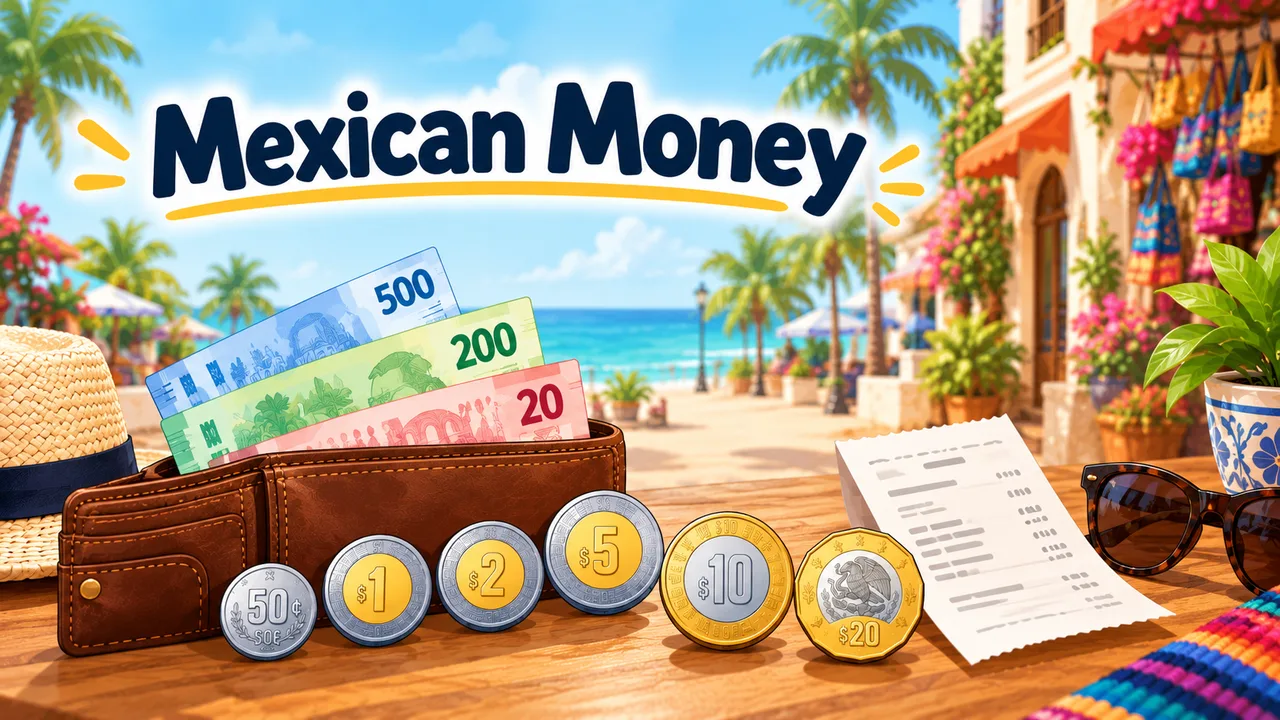
One peso is divided into 100 centavos. Mexican money comes in coins and bills, and the large number printed on each tells you its denomination.
The easiest way to get comfortable with Mexican money is to learn what the common coins and bills look like, then practice saying the amounts in Spanish.
The Simple Rule
- In Mexico, $ normally means pesos.
- $100 = cien pesos
- $500 = quinientos pesos
- $1,000 = mil pesos
- 50¢ = cincuenta centavos
- If a price is in U.S. dollars, it should be identified by USD, US$, dólares, or other clear context. When you're unsure, ask.
Pesos vs. centavos
The peso is Mexico's main currency unit, and MXN is the code that identifies the Mexican peso internationally (you'll see it on card terminals and exchange-rate boards).
One peso is made up of 100 centavos, so 50 centavos is half a peso.
In Mexican prices, the $ sign generally means pesos. Banco de México puts the same $ symbol right on its peso coins.
Paying by card and asked to choose MXN or USD? See Pesos or Dollars?
- $0.50
50 centavos
- $1.00
1 peso
- $10.50
10 pesos and 50 centavos
- $99.90
99 pesos and 90 centavos
- $100.00
100 pesos
Ask Playa Tip
The decimal point matters. $10.50 is ten pesos and fifty centavos, not 1,050 pesos.
Meet the Mexican coins
These are the coins you'll handle most often. Tap the speaker to hear each one in Spanish.
The familiar $1, $2 and $5 coins have a gold-colored center and a silver-colored outer ring. The $10 coin reverses that: a silver-colored center with a gold-colored ring. The current $20 coins are 12-sided.
50¢
cincuenta centavosfifty centavosSmall, round and silver-colored (17 mm).
Official 50¢ coin (Banco de México)$1
un pesoone pesoGold-colored center, silver-colored ring (21 mm).
Official $1 coin (Banco de México)$2
dos pesostwo pesosGold-colored center, silver-colored ring (23 mm).
Official $2 coin (Banco de México)$5
cinco pesosfive pesosGold-colored center, silver-colored ring (25.5 mm).
Official $5 coin (Banco de México)$10
diez pesosten pesosReversed colors: silver-colored center, gold-colored ring (28 mm).
Official $10 coin (Banco de México)$20
veinte pesostwenty pesosCurrent coins are 12-sided, with a silver-colored center and gold-colored ring (30 mm). Pictures vary.
Official $20 coins (Banco de México)
Simplified graphics, not pictures of real coins: they show each coin's colors, shape and relative size. Follow the links for Banco de México's official images. Smaller 5-, 10- and 20-centavo coins also exist.
$20 coins come in many designs
Many 20-peso coins are commemorative, so the picture changes from one to the next. In 2026, Banco de México released 12-sided $20 coins for the FIFA World Cup, with Mexico City, Guadalajara, Monterrey and Mexico designs.
Banco de México also lists many earlier commemorative 20-peso designs as still valid, such as the 500 years of the city and port of Veracruz and the centennial of Mexico's Air Force. Some older ones have a different shape.
Don't identify a coin by its picture alone. Check the denomination, shape and other features.
Meet the Mexican bills
Mexico's newest banknotes are called Family G. Each value has its own main color, and the bills get longer as the value goes up, from the 120 mm $20 to the 153 mm $1,000.
$20
veinte pesostwenty pesosRed and green, made of polymer. The back shows the mangroves of Sian Ka'an, here in Quintana Roo, with a crocodile.
Official $20 bill (Banco de México)$50
cincuenta pesosfifty pesosPurple. The back shows an ajolote (axolotl) in Xochimilco.
Official $50 bill (Banco de México)$100
cien pesosone hundred pesosRed. The front shows Sor Juana Inés de la Cruz; the back shows monarch butterflies.
Official $100 bill (Banco de México)$200
doscientos pesostwo hundred pesosGreen. The front shows Miguel Hidalgo and José María Morelos; the back shows an eagle over the desert.
Official $200 bill (Banco de México)$500
quinientos pesosfive hundred pesosBlue. The front shows Benito Juárez; the back shows a gray whale and her calf.
Official $500 bill (Banco de México)$1,000
mil pesosone thousand pesosGray. The front shows Francisco I. Madero, Hermila Galindo and Carmen Serdán; the back shows a jaguar.
Official $1,000 bill (Banco de México)
Simplified graphics, not pictures of real bills: they show each bill's main color and relative length. For the real designs, see Banco de México's current banknotes and coins.
- A bill might look different and still be real
Older designs can still be in circulation
Mexico has introduced new banknote designs over time, and older valid designs can stay in circulation alongside the newer ones. Banco de México explains that notes being gradually withdrawn still keep their full value; banks simply stop handing them back out.
Don't assume a bill is counterfeit just because its picture or color differs from the one in this guide. Check the denomination and the official security features.
- Yes, $20 can be a coin or a bill
Both are worth 20 pesos
Both are called veinte pesos, and both pay for exactly the same thing.
How to say money in Spanish
One: un peso. More than one: dos pesos, diez pesos, cien pesos.
For centavos it works the same way: un centavo, cincuenta centavos.
- $1un pesooon PEH-soh
- $2dos pesosdohs PEH-sohs
- $5cinco pesosSEEN-koh PEH-sohs
- $10diez pesosdyehs PEH-sohs
- $20veinte pesosBAYN-teh PEH-sohs
- $50cincuenta pesosseen-KWEHN-tah PEH-sohs
- $100cien pesossyehn PEH-sohs
- $200doscientos pesosdohs-SYEHN-tohs PEH-sohs
- $500quinientos pesoskee-NYEHN-tohs PEH-sohs
- $1,000mil pesosmeel PEH-sohs
- 1¢un centavooon sehn-TAH-boh
- 50¢cincuenta centavosseen-KWEHN-tah sehn-TAH-bohs
Cien or ciento?
- $100cien pesossyehn PEH-sohs
- $120ciento veinte pesosSYEHN-toh BAYN-teh PEH-sohs
- $150ciento cincuenta pesosSYEHN-toh seen-KWEHN-tah PEH-sohs
- $175ciento setenta y cinco pesosSYEHN-toh seh-TEHN-tah ee SEEN-koh PEH-sohs
Exactly 100 is cien. For 101–199, you generally use ciento.
How would I say this price?
Tap the speaker to hear the whole amount, exactly as it's written.
- $15quince pesosKEEN-seh PEH-sohs
- $25veinticinco pesosbayn-tee-SEEN-koh PEH-sohs
- $30treinta pesosTRAYN-tah PEH-sohs
- $45cuarenta y cinco pesoskwah-REHN-tah ee SEEN-koh PEH-sohs
- $50cincuenta pesosseen-KWEHN-tah PEH-sohs
- $75setenta y cinco pesosseh-TEHN-tah ee SEEN-koh PEH-sohs
- $100cien pesossyehn PEH-sohs
- $120ciento veinte pesosSYEHN-toh BAYN-teh PEH-sohs
- $150ciento cincuenta pesosSYEHN-toh seen-KWEHN-tah PEH-sohs
- $175ciento setenta y cinco pesosSYEHN-toh seh-TEHN-tah ee SEEN-koh PEH-sohs
- $200doscientos pesosdohs-SYEHN-tohs PEH-sohs
- $250doscientos cincuenta pesosdohs-SYEHN-tohs seen-KWEHN-tah PEH-sohs
- $300trescientos pesostrehs-SYEHN-tohs PEH-sohs
- $350trescientos cincuenta pesostrehs-SYEHN-tohs seen-KWEHN-tah PEH-sohs
- $500quinientos pesoskee-NYEHN-tohs PEH-sohs
- $750setecientos cincuenta pesosseh-teh-SYEHN-tohs seen-KWEHN-tah PEH-sohs
- $1,000mil pesosmeel PEH-sohs
- $1,500mil quinientos pesosmeel kee-NYEHN-tohs PEH-sohs
- $2,000dos mil pesosdohs meel PEH-sohs
What did they just say?
Cashiers often leave out the word pesos when it's clear you're talking about money. You'll hear just the number:
- Son cincuenta.sohn seen-KWEHN-tahIt's 50.
- Son cien.sohn syehnIt's 100.
- Son ciento cincuenta.sohn SYEHN-toh seen-KWEHN-tahIt's 150.
- Son doscientos veinte.sohn dohs-SYEHN-tohs BAYN-tehIt's 220.
- Son quinientos.sohn kee-NYEHN-tohsIt's 500.
Listening cheat sheet
- 50cincuentaseen-KWEHN-tah
- 100ciensyehn
- 150ciento cincuentaSYEHN-toh seen-KWEHN-tah
- 200doscientosdohs-SYEHN-tohs
- 300trescientostrehs-SYEHN-tohs
- 500quinientoskee-NYEHN-tohs
- 1,000milmeel
Easy to mix up
cincuenta = 50
quinientos = 500
They're easy for beginners to confuse. It's completely fine to ask someone to repeat a price or write it down: “¿Me puede repetir el precio?” -- “Can you repeat the price?”
Paying with cash
Cash is useful in Playa, particularly for smaller everyday purchases and situations where cards aren't accepted.
A $500 or $1,000 bill can be inconvenient for a small purchase if the business doesn't have enough change available. A few practical habits help:
- Look at the denomination before handing over a bill.
- Count your change before putting it away.
- Carry a mix of smaller bills and coins when practical.
- Don't assume every small business or driver can change a large bill.
- If you need change for a large bill, ask before purchasing.
How to ask for change
- ¿Tiene cambio?TYEH-neh KAHM-byohDo you have change?
- ¿Tiene cambio de quinientos?TYEH-neh KAHM-byoh deh kee-NYEHN-tohsDo you have change for 500 pesos?
- ¿Me puede cambiar este billete?meh PWEH-deh kahm-BYAR EHS-teh bee-YEH-tehCan you change this bill for me?
Prices with centavos
When a price has centavos, the full version joins the two parts with con (“with”). In conversation, people often drop the words pesos and centavos.
- $89.50ochenta y nueve pesos con cincuenta centavosoh-CHEHN-tah ee NWEH-beh PEH-sohs kohn seen-KWEHN-tah sehn-TAH-bohs$89.50 (89 pesos and 50 centavos)
- $89.50ochenta y nueve con cincuentaoh-CHEHN-tah ee NWEH-beh kohn seen-KWEHN-tah$89.50, said casually
- $125.75ciento veinticinco pesos con setenta y cinco centavosSYEHN-toh bayn-tee-SEEN-koh PEH-sohs kohn seh-TEHN-tah ee SEEN-koh sehn-TAH-bohs$125.75 (125 pesos and 75 centavos)
What about counterfeit money?
An unfamiliar design doesn't automatically mean a bill is counterfeit: older designs and commemorative coins are still in use.
Banco de México's own guide to checking a banknote comes down to three steps: touch it, look at it against the light, and tilt it to see the security features change.
If you suspect a bill or coin is counterfeit, don't try to pass it to someone else. Banco de México says not to use it for payments and to take it to any bank branch, which sends it to Banco de México for analysis free of charge. If the bank keeps it, ask for the retention receipt.
Common newcomer mistakes
- 1. Assuming $100 means U.S. dollars
In Mexico, $ normally means pesos.
- 2. Confusing centavos and pesos
$10.50 is ten pesos and fifty centavos.
- 3. Thinking a different-looking $20 coin is fake
Many $20 coins are commemorative designs.
- 4. Assuming an older-looking bill is counterfeit
Older designs can still be valid.
- 5. Confusing cincuenta and quinientos
cincuenta = 50, quinientos = 500.
- 6. Paying for a small purchase with a large bill
Check whether they have change first.
- 7. Thinking a 500-peso bill means 500 U.S. dollars
It's 500 Mexican pesos.
- 8. Expecting people to always say pesos
“Son cien” means it's 100 pesos.
- 9. Being embarrassed to ask someone to repeat a price
Asking is normal, and so is asking them to write it down.
- 10. Memorizing pictures instead of denominations
Designs change; the number tells you the value.
Useful Spanish
- ¿Cuánto cuesta?KWAN-toh KWES-tahHow much does it cost?
- ¿Cuánto es?KWAHN-toh ehsHow much is it?
- ¿Me puede repetir el precio?meh PWEH-deh reh-peh-TEER ehl PREH-syohCan you repeat the price?
- ¿Me lo puede escribir?meh loh PWEH-deh ehs-kree-BEERCan you write it down for me?
- Son cien pesos.sohn syehn PEH-sohsIt's 100 pesos.
- ¿Tiene cambio?TYEH-neh KAHM-byohDo you have change?
- ¿Tiene cambio de quinientos?TYEH-neh KAHM-byoh deh kee-NYEHN-tohsDo you have change for 500 pesos?
- ¿Me puede cambiar este billete?meh PWEH-deh kahm-BYAR EHS-teh bee-YEH-tehCan you change this bill for me?
- En pesos, por favor.ehn PEH-sohs, por fah-VORIn pesos, please.
- ¿Aceptan efectivo?ah-SEHP-tahn eh-fehk-TEE-bohDo you take cash?
- ¿Puedo pagar con tarjeta?PWEH-doh pah-GAR kohn tar-HEH-tahCan I pay by card?
Final tips
Mexican money becomes much easier once you stop trying to convert every number in your head.
Start by recognizing the coins and bills. Then learn to hear common amounts like cincuenta, cien, doscientos and quinientos.
Look at the number. Learn what it sounds like. Ask when you're unsure.
And remember: in Playa del Carmen, a price marked $ normally means Mexican pesos. Wondering which currency to choose at a card terminal or ATM? See Pesos or Dollars?
 Frequently Asked Questions
What currency is used in Playa del Carmen?
The Mexican peso (MXN).
Does $100 mean 100 dollars in Mexico?
Normally, a price marked $100 in a Mexican store means 100 Mexican pesos. U.S.-dollar prices should be identified by USD or other clear context.
How many centavos are in a peso?
100.
What coins does Mexico use?
Common denominations include 50 centavos and 1-, 2-, 5-, 10- and 20-peso coins. Smaller centavo coins also exist.
Does Mexico have a 20-peso bill and a 20-peso coin?
Yes. Both have a face value of 20 pesos.
Why do some Mexican bills look different?
Mexico has introduced multiple banknote designs, and some older designs remain valid alongside newer ones.
How do you say 100 pesos in Spanish?
Cien pesos.
How do you say 500 pesos in Spanish?
Quinientos pesos.
How do you say 1,000 pesos in Spanish?
Mil pesos.
What if I don't understand the amount someone says?
Ask them to repeat it: “¿Me puede repetir el precio?” You can also ask them to write it down.
Should I pay in pesos or dollars in Playa?
Use pesos as your everyday default. For card-terminal and ATM conversion choices, see Ask Playa's separate Pesos or Dollars guide.
 Sources
- Banco de México: Currently manufactured banknotes and coins
- Banco de México: 20-peso current coins (C1-type) and other valid designs
- Banco de México: 10-peso coin (C-type)
- Banco de México: 1-peso coin (C-type)
- Banco de México: Banknotes and coins being withdrawn (en proceso de retiro)
- Banco de México: Banknote authenticity verification
- Banco de México: Suspected counterfeit banknotes and coins (piezas presuntamente falsas)

Was This Helpful?