

Playa’s Secret Cenotes: The Hidden World Beneath the City
Beneath Playa del Carmen's streets, homes and businesses lies a remarkable world of limestone caves, hidden freshwater and ancient natural history. Here's what most residents never realize is right beneath their feet.
 Reviewed for Accuracy
 Last Verified: October 17, 2026
 No Login. Just Answers.
 Quick Answer
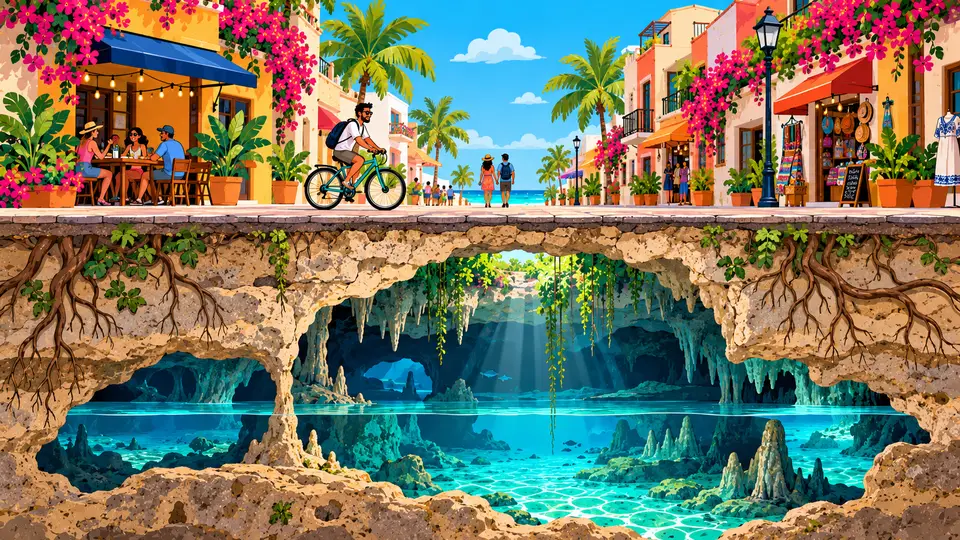
Yes! Playa del Carmen sits on porous limestone that contains natural caves, cavities and groundwater. Cenotes exist within the urban area, including places that have developed into busy neighborhoods.
Local explorers have spent years documenting and protecting these underground environments.
But that doesn't mean there's one giant cave beneath the entire city—or that every building sits above an open cavern. The underground landscape varies considerably from place to place.
A Whole Other Playa Exists Beneath Your Feet
Picture an ordinary afternoon in Playa del Carmen.
You're walking to the grocery store, driving down a busy avenue or sitting in your favorite café. There's traffic, construction, delivery motorcycles and the usual sounds of city life.
But beneath all that activity, there's something extraordinary.
Hidden below the pavement are natural limestone cavities, underground water passages and cenotes that have existed for thousands of years.
Some are small openings in the ground. Others lead into larger cave environments. Some are filled with freshwater, while others contain air-filled chambers or a combination of both.
And many are completely invisible from the street.
The Playa del Carmen you know is only part of the story.
The City Above, a Different World Below
To understand Playa's hidden cenotes, you first need to understand what the city is built on.
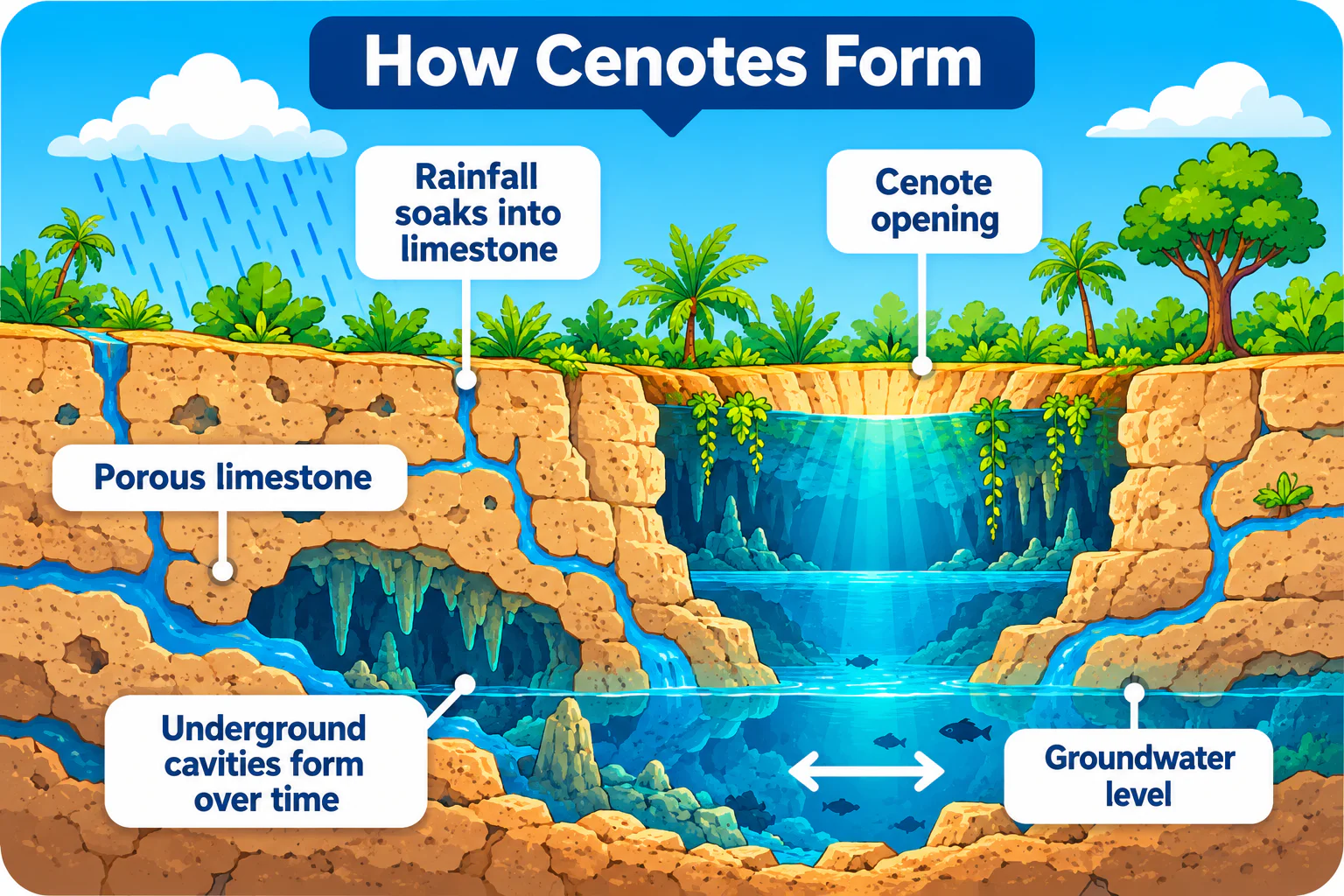
Much of the Yucatán Peninsula consists of limestone, a type of rock that can gradually dissolve when exposed to slightly acidic water.
Over enormous stretches of geological time, rainwater seeps into the ground and slowly enlarges cracks and openings.
Eventually, those openings can become underground passages, chambers and cave systems.
When part of a cave ceiling collapses or an opening develops that exposes the groundwater below, a cenote can form.
That's why cenotes come in so many different shapes.
Some look like open ponds. Others resemble deep wells. Some are tucked beneath overhanging rock, while others are accessible only through narrow openings.
The spectacular swimming cenotes outside Playa are simply the most familiar examples of a much larger geological story.
How Many Secret Cenotes Are There?
Here's where things get interesting.
In December 2023, the municipal government reported 226 cenotes within the municipality then known as Solidaridad.
That sounds like a remarkable number—and it is.
But there's an important distinction: 226 was a municipality-wide figure, not a confirmed count of cenotes beneath central Playa del Carmen.
The municipality covered a much larger area than the city's downtown streets and residential neighborhoods. The figure was also reported in 2023, so it shouldn't be presented as a current, independently verified total.
The exact number of urban cenotes isn't established by that report.
And counting them isn't necessarily straightforward.
Some openings may be hidden by vegetation, enclosed within private properties or obscured by development. Underground cave passages can also connect multiple openings, so counting entrances isn't the same thing as counting separate cave systems.
What's clear is that Playa's underground landscape is far more extensive than most people realize.
The People Exploring Playa's Hidden World
One of the most fascinating parts of this story isn't underground at all.
It's the group of people determined to understand and protect what's down there.
Cenotes Urbanos began in 2018, founded by Roberto Rojo, Talismán Cruz and Ximena Chávez.
Their mission goes well beyond exploring caves for adventure.
The organization brings together volunteers, researchers and cave enthusiasts to document underground environments, study wildlife, promote conservation and educate the community.
According to its published history, more than 400 volunteers have participated in its work.
Its activities include cave mapping, environmental education, wildlife monitoring, training and organized cleanups.
The organization reports exploration, mapping and biodiversity documentation involving more than 150 caves and cenotes across the Yucatán Peninsula—not exclusively beneath Playa del Carmen.
Its achievements also include monitoring cave animals and cleaning underground environments.
Their work is helping make an invisible part of Playa more understandable to the people who live above it.
Sources: Cenotes Urbanos — History and Achievements.
Ancient Discoveries Beneath Modern Playa
Here's something worth thinking about the next time you're stuck in traffic.
The rock beneath Playa has a history that began long before the first modern road, neighborhood or resort was built.
The Yucatán Peninsula's cave systems developed through geological processes spanning immense periods of time, including changes in groundwater and sea levels.
Some caves that are underwater today were once dry.
As sea levels changed, portions of these underground environments flooded, preserving evidence of their earlier conditions.
Across the wider Yucatán Peninsula, cave and cenote research has contributed to our understanding of ancient environments and the region's natural and human history.
But it's important not to confuse discoveries made elsewhere on the peninsula with discoveries specifically documented beneath Playa's urban neighborhoods.
The remarkable thing about Playa's underground world doesn't require an archaeological treasure story.
Its geology is fascinating enough on its own.
The Underground Connection to the Caribbean
Here's another surprising fact: the freshwater beneath Playa is part of a much larger groundwater system.
Unlike places where rivers flow visibly across the landscape, much of the Yucatán Peninsula's water moves through underground limestone.
Rainwater filters into the ground, enters fractures and cavities, and becomes part of the regional aquifer.
In coastal areas, groundwater movement and interactions between freshwater and saltwater can be especially complex.
This means what happens inland can matter to coastal water environments.
But that doesn't mean every cenote connects to the Caribbean through a single continuous underwater tunnel.
Groundwater can move through different kinds of openings and pathways, and those connections must be established through scientific investigation rather than assumed.
The important idea is simpler:
The city, its groundwater and its coastal environment are connected parts of the same natural landscape.
What Scientists Are Finding in Playa's Cenotes
Unfortunately, Playa's underground world faces pressures that aren't visible from the street.
A scientific study published in Environmental Research in 2026 examined water and sediment contamination in nine cenotes in Playa del Carmen.
Researchers looked for several types of contaminants, including microplastics, potentially toxic elements and PFAS—a group of persistent manufactured chemicals.
They found microplastics in all nine cenotes studied.
The most urbanized sites generally showed greater contamination, and PFAS were detected in the urban cenotes sampled.
The study linked higher pollution burdens with urban development and raised concerns about inadequate wastewater treatment and pressure on the region's groundwater system.
That's significant.
But it does not mean scientists tested every cenote in Playa or found that every cenote is contaminated.
The research examined a specific group of nine sites. Its findings highlight an environmental risk that deserves attention, rather than establishing the condition of every underground water source in the city.
Source: Environmental Research, 2026. DOI: 10.1016/j.envres.2026.124653.
Can You Actually See an Urban Cenote?
Yes, although many urban cenotes aren't places you can simply walk into.
Some are located on private property. Others may be environmentally sensitive, physically dangerous or accessible only to trained explorers.
A cenote opening that looks small or harmless from above can lead to deep water, unstable rock or complicated cave passages.
Never enter an unmarked cave or cenote, cross onto private property or assume an opening is safe to explore.
If you're curious about Playa's underground environment, look for educational activities or conservation opportunities organized by reputable local groups rather than attempting to find hidden entrances yourself.
One Example You May Already Know: Punta Esmeralda
Punta Esmeralda is a familiar coastal area where a cenote, mangrove habitat and beach environment exist close together.
It's a visible reminder that cenotes aren't always isolated jungle pools far outside the city.
In April 2026, Playa del Carmen's municipal government reported a cleanup of the Punta Esmeralda cenote and nearby mangrove area.
Workers collected discarded glass, plastics and other waste from these sensitive environments.
The cleanup shows why caring for urban cenotes matters even when they're in familiar public areas.
Access and swimming conditions can change, so don't assume the cenote is currently open or safe for swimming based on this article.
Source: Municipal Punta Esmeralda cleanup report, April 2026.
Why Residents Should Care
You don't need to be a cave explorer to have a reason to care about what lies beneath Playa.
The underground environment is part of the place you call home.
And ordinary decisions aboveground can affect it.
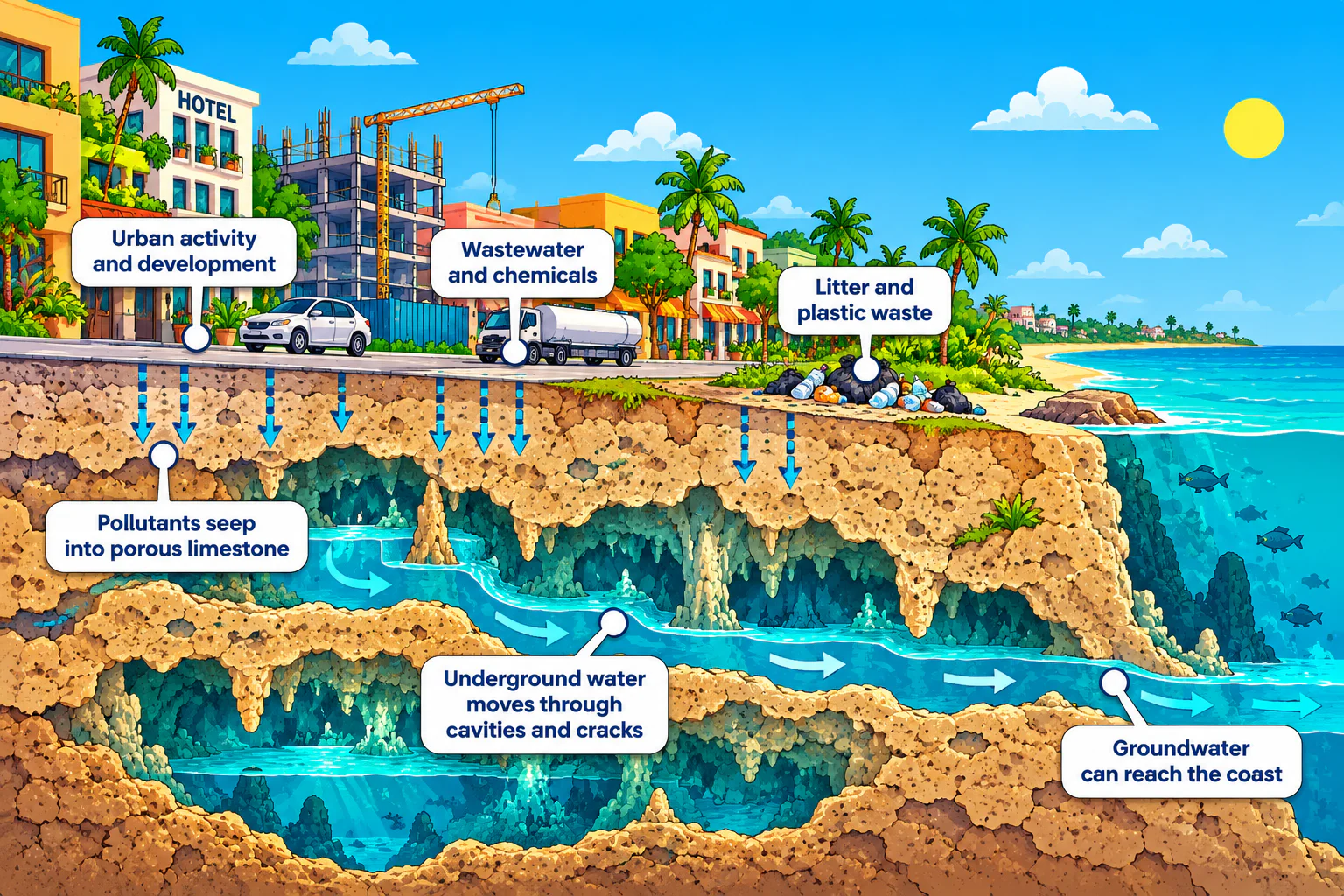
Improperly discarded chemicals, litter, leaking wastewater and poorly managed development can create risks for the groundwater system.
Because limestone is porous and water can move through underground openings, protecting the aquifer requires attention to what happens at the surface.
There's also wildlife to consider.
Caves provide specialized habitats for animals adapted to darkness, including certain fish, crustaceans and bats. Cenotes Urbanos identifies cave wildlife monitoring as one of its ongoing areas of work.
These environments aren't empty holes in the ground.
They're ecosystems.
And once they're damaged, restoring them can be extremely difficult.
For residents, the practical takeaway is to dispose of waste responsibly, avoid dumping chemicals, respect protected areas and support legitimate conservation efforts.
Small actions aboveground help protect a world most of us will never see.
Appreciate It From Above
Ask Playa Tip
You don't have to go underground to appreciate Playa's cenotes.
Next time you're walking through your neighborhood, remember that the city is built on a remarkable natural landscape.
If you want to learn more, explore the educational and conservation work of Cenotes Urbanos.
And if you encounter an unfamiliar opening, cave or flooded cavity, admire it from a safe distance. Don't enter or share an unverified entrance location as an invitation to explore.
The best way to protect Playa's hidden world is to understand that it's there.
A Different Way to See Playa
Most people associate Playa del Carmen with turquoise water, white sand, restaurants and busy streets.
But the city has another side.
One that's quiet, dark and largely unseen.
It's a landscape shaped by water and limestone over immense stretches of time. A place where researchers are still learning about groundwater, cave wildlife and the effects of a growing city.
And it's right beneath everyday life.
So the next time you're walking down a familiar street, consider this:
There may be a whole other world beneath your feet.
That's a pretty extraordinary thing to know about the place you live.
 Frequently Asked Questions
Are there really cenotes underneath Playa del Carmen?
Yes. Playa del Carmen sits on porous limestone that contains natural caves, cavities and groundwater, and cenotes exist within the urban area. That doesn't mean there's one giant cave under the whole city: the underground landscape varies from place to place.
How many cenotes are there in Playa del Carmen?
In December 2023 the municipal government reported 226 cenotes in the municipality then known as Solidaridad. That was a municipality-wide figure, not a count of cenotes beneath central Playa, and the exact number of urban cenotes isn't established by that report.
Who explores Playa's urban cenotes?
Cenotes Urbanos, founded in 2018 by Roberto Rojo, Talismán Cruz and Ximena Chávez, brings together volunteers, researchers and cave enthusiasts to map caves, monitor cave wildlife, run environmental education and organize cleanups.
Are Playa's cenotes contaminated?
A 2026 study in Environmental Research examined nine cenotes in Playa del Carmen and found microplastics in all of them, with the most urbanized sites generally showing greater contamination. It did not test every cenote, and it doesn't mean every cenote in Playa is contaminated.
Can I visit or swim in an urban cenote in Playa?
Many urban cenotes are on private property, environmentally sensitive, dangerous or accessible only to trained explorers. Never enter an unmarked cave or cenote. Access and swimming conditions can change, so don't assume any urban cenote, including Punta Esmeralda's, is open or safe for swimming.
How can residents help protect Playa's cenotes?
Dispose of waste responsibly, avoid dumping chemicals, respect protected areas and support legitimate conservation efforts. Because limestone is porous, what happens at the surface can affect the groundwater below.
 Sources
- City of Playa del Carmen: 2023 environment report (226 cenotes across the former municipality of Solidaridad)
- Cenotes Urbanos: History (origins, mission, citizen science and conservation)
- Cenotes Urbanos: Achievements (exploration, mapping, wildlife monitoring and cleanups)
- Environmental Research (2026): contamination in nine Playa del Carmen cenotes
- City of Playa del Carmen: Punta Esmeralda cenote and mangrove cleanup (April 2026)

Was This Helpful?