

How Do I Avoid Rental Scams in Playa?
How to check a listing, verify a landlord or agent, protect your deposit and spot warning signs before you send money.
 Reviewed for Accuracy
 Last Verified: October 25, 2026
 No Login. Just Answers.
 Quick Answer
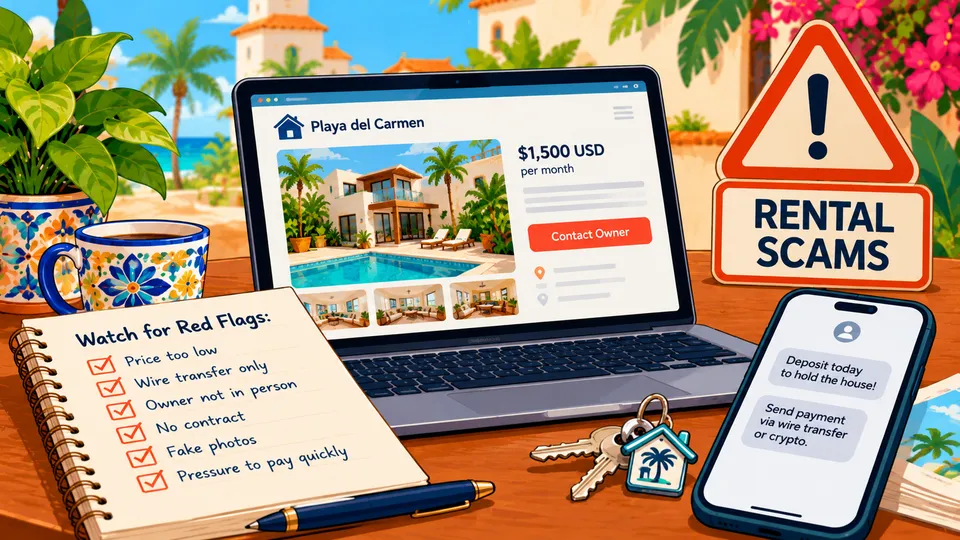
The safest way to avoid a rental scam in Playa del Carmen is to verify the property, the person offering it and the payment details before you send any money.
Don't rely only on attractive photos, a Facebook listing, a WhatsApp conversation or even a signed contract.
Ask to see the home, confirm who owns it or has the authority to rent it, review the rental terms and know exactly who will receive your payment.
The most important rule: never let pressure to send a deposit replace checking.
How Do Rental Scams Work in Playa?
Someone may advertise a home they don't own, copy photos from a real listing or pretend to represent a real landlord. Mexico's federal security ministry (SSPC) describes the usual pattern: an unusually cheap listing on social media, a move to a messaging app, a fake ID or contract, and a request for an advance deposit. Once paid, the ad disappears and the person stops answering.
- Fake listing
- A home advertised with photos and details copied from another listing.
- Impersonated owner
- Someone claims to own the home but can't show they have the right to rent it.
- Fake agent or manager
- Someone claims to represent an owner or management company without authorization.
- Advance-payment scam
- You're pushed to pay a deposit or reservation fee before you've been able to check anything.
- Conflicting listings
- The same home appears in several ads with different prices, contacts or availability.
Listings aren't the problem
Facebook Marketplace, rental groups and WhatsApp aren't fraudulent in themselves. The risk comes from treating a listing or a conversation as proof.
Verify the Property Itself
Before you pay anything, confirm the home is real, accurately described and actually available.
- Check the address
- Ask for the full address and make sure it matches the home in the ad. In a condominium, confirm the building and unit.
- Ask for a viewing
- Visit in person whenever you can. If you can't, the SSPC suggests a live video call that shows the whole home.
- Compare listings
- Search for the same home on other sites and look for different prices, contact names, descriptions or availability. A duplicate isn't proof of fraud, since several authorized agents may advertise one home, but unexplained differences are worth asking about.
- Be careful with photos
- Photos can be copied. A reverse image search can show where they've appeared before, but it doesn't tell you whether the person offering the home is authorized.
Ask Playa Tip
A real address and real photos prove very little about who's entitled to rent the home. You still need to check the person offering it.
How Do I Verify the Landlord?
Ask who legally owns the home and who will sign the lease. If you're dealing with the owner, ask for reasonable proof of identity and ownership. If it's someone else, ask how they're authorized to rent it. Questions to ask:
- Who is the legal owner?
- Who will sign the lease?
- Who receives the deposit, and who receives the monthly rent?
- Who handles maintenance?
- Is the person offering the home authorized to do so?
No single document settles it
Check that the names on any ID or property documents match the proposed agreement. But an ID or a photo of a document can be forged or misused, so don't treat any single document as conclusive.
Owning a home and having the authority to rent it are related but not the same: an authorized representative can legitimately rent a home for its owner. The question is whether that authorization can be shown.
Can I Check Property Ownership in Quintana Roo?
Yes. Quintana Roo's Registro Público de la Propiedad y del Comercio (RPPC) keeps property records. Its free online Portal Ciudadano needs an account. The state says it lets you run public searches on properties, verify registry documents by scanning their QR code, and request certified copies, proof of ownership (constancia de propiedad) or a certificate of liens (certificado de libertad de gravamen) online. Check what each request involves when you make it.
- What it can help with
- Registered property information, ownership records and recorded legal interests, through the registry's official services.
- What it can't guarantee
- That a listing is genuine, that the home is available, that the person messaging you is the owner, that an agent may rent it, or that the deal is safe. Records also have to be read correctly, and some ownership arrangements need more documents.
For a big or complicated rental
Consider asking a qualified local professional to help check the property and the authority of the person offering it. Use the government's own registry services, not unofficial sites claiming to sell certified ownership information.
How Do I Verify a Real Estate Agent or Property Manager?
An agent or manager can legitimately rent a home for its owner, but a professional look or online profile doesn't prove they're authorized. Ask:
- Which company do you work for?
- Who owns the home?
- Are you authorized to offer this specific home?
- Who will sign the lease, and who receives the payment?
- Who manages the rental after move-in?
Confirm it independently
Contact the agency or management company using contact details you found yourself, not only the phone number or website the person gave you. If you can reach the owner independently, confirm the representative's authority with them.
What If I'm Renting Before I Arrive?
Many newcomers start looking while still outside Mexico, which makes checking harder.
- Ask for a live video walkthrough
- Ask to see the entrance, the street or building outside, the kitchen, bathrooms, bedrooms, air conditioners, outdoor areas and any promised amenities in real time, and ask for specific details that old photos couldn't show.
- Get someone local to look
- If you can, have someone you trust in Playa see the home. It helps confirm the home exists and its condition, but it doesn't establish who can rent it.
- Consider a short stay first
- If you can't check a long-term rental properly from abroad, book temporary accommodation and see homes in person after you arrive.
- Don't rush
- A good home may really have other applicants, but that shouldn't stop reasonable checking.
A video call isn't proof
A live video call shows someone has access to the home. It doesn't show they own it or may rent it.
Should I Pay a Deposit Before Signing?
Legitimate rentals often involve a security deposit, advance rent or a reservation payment, so an upfront payment isn't automatically a scam. The risk is paying before you understand and verify the deal. The SSPC advises against paying in advance without a signed lease. Before you pay, confirm:
- The exact home and its address.
- Who is receiving the payment, and their authority to offer the rental.
- The amount and what it covers.
- Whether it's refundable, and whether it counts toward rent or the deposit.
- What happens if the rental doesn't go ahead.
- Whether you'll get a receipt.
- That the written terms match the payment request.
Apartados and payment changes
An apartado is a reservation or holding payment. Its terms vary, so don't assume it's refundable, or that it isn't, without reading the agreement.
Be especially careful if the receiving bank account suddenly changes, or if you're asked to pay someone who isn't part of the documented rental. Check any change independently before paying.
What's the Safest Way to Pay?
No payment method guarantees protection from rental fraud, but clear records help if something goes wrong. Before you send money, verify the recipient's name and account details, understand what the payment is for, review the written terms, and keep every record.
- Bank transfers
- They leave a record, and the SSPC recommends traceable payments such as a transfer to an account in the landlord's name. But a transfer isn't automatically reversible: what can be done depends on the bank and the circumstances.
- Cash
- Cash is hard to trace without documentation. Get a clear receipt showing who received it, the amount, the date, the property and what it's for.
- Payment apps
- Don't assume a payment service's buyer protection covers rental deposits. Check that provider's terms.
A receipt isn't proof either
A receipt documents a payment. It doesn't prove the rental is legitimate.
Protect Your Personal Information
Rental applications can involve ID and other personal details, and landlords can legitimately ask for them. But scammers also collect documents to misuse them: CONDUSEF warns that rental scammers ask for a photo of your ID along with the deposit.
Ask why a document is needed and who will receive it, use secure ways to send it, and don't send sensitive information to someone you haven't verified. Be careful with:
- Passport and residency documents.
- Bank statements and account details.
- Your home-country address.
- Passwords and one-time security codes.
Never share these
No rental application needs your passwords or one-time banking codes. Never share them.
Rental Scam Warning Signs
Be careful when:
- The rent is far below similar homes.
- The person won't arrange a viewing or an independent inspection.
- The address or details keep changing.
- The person can't reasonably show they can rent the home.
- You're pressured to send money right away.
- You're asked to pay someone unrelated to the rental.
- The agreement is incomplete or inconsistent.
- The person won't give you a receipt.
- The photos appear in conflicting listings.
- You're asked for banking passwords or codes.
- Someone says checking isn't necessary.
Remember
One warning sign doesn't always mean fraud, but sort out any unexplained inconsistency before you go ahead. If you can't verify the home, the person or the payment, don't send money.
Before You Send Money
Go through this before paying any deposit, advance rent or reservation fee.
0 of 12 done
Completing this checklist can help you avoid common risks, but it can't guarantee a rental is legitimate.
Your ticks are saved on this device only.
Ask Playa Tip
The biggest warning sign isn't always a suspicious price. Sometimes it's the pressure to pay before you've had a chance to check anything.
A real-looking listing, professional photos, a friendly agent and a written contract can all appear in a scam. Before you send money, independently verify the home, the person offering it and who receives the payment.
What Should I Do If I Think I've Been Scammed?
If you think you've sent money to a fake rental, act quickly.
- 1. Call your bank or payment provider
- Tell them you suspect fraud and ask whether a recall, dispute or other fraud process is available. The sooner you report it, the more options they may have, but getting the money back isn't guaranteed.
- 2. Keep the evidence
- Save the ad and its link, screenshots, WhatsApp chats, emails, contracts, payment confirmations, the bank account details, phone numbers, and any names or ID the other person gave you. Don't delete anything.
- 3. Report it to the Fiscalía
- Quintana Roo's state prosecutor (Fiscalía General del Estado) has an online service at enlinea.fgeqroo.gob.mx, though not every case can be completed online. Its Playa del Carmen office is on Calle Zapote between Ceiba and Caoba, Misión Villamar 1, phone 984 873 0163 (from the Fiscalía's website, October 2026). Confirm the location and hours before you go. The SSPC also says you can contact your state's cyber police unit.
- 4. Report the listing
- Report the ad or account to the website, social network or messaging app. It may help protect others, but they may not act on it.
- 5. Protect your identity
- If you shared sensitive information, change any compromised passwords, contact the affected banks, secure your email and financial accounts, and watch for unusual activity.
- 6. Watch for recovery scams
- The SSPC warns about people who contact scam victims offering to get their money back for an upfront fee, sometimes posing as authorities or a “digital prosecutor”. Don't send more money to anyone claiming they can recover it.
Emergency?
If you're in immediate danger in Mexico, call 911. A rental fraud with no emergency should go to your bank and the Fiscalía.
Useful Spanish
¿Tiene autorización para rentar esta propiedad?
TYEH-neh ow-toh-ree-sah-SYOHN PAH-rah rehn-TAR EHS-tah proh-pyeh-DAHD
Do you have authorization to rent this property?
¿Puedo revisar el contrato antes de pagar?
PWEH-doh reh-bee-SAR ehl kohn-TRAH-toh AHN-tehs deh pah-GAR
Can I review the contract before paying?
¿A nombre de quién está la cuenta bancaria?
ah NOHM-breh deh kyehn ehs-TAH lah KWEHN-tah bahn-KAH-ryah
Whose name is on the bank account?
¿Podemos visitar la propiedad?
poh-DEH-mohs bee-see-TAR lah proh-pyeh-DAHD
Can we visit the property?
¿Usted es el propietario?
oos-TEHD ehs ehl proh-pyeh-TAH-ryoh
Are you the owner?
¿Me puede mostrar un documento que acredite la propiedad?
meh PWEH-deh mohs-TRAR oon doh-koo-MEHN-toh keh ah-kreh-DEE-teh lah proh-pyeh-DAHD
Can you show me a document proving ownership?
¿Podemos hacer una videollamada en vivo?
poh-DEH-mohs ah-SEHR OO-nah bee-deh-oh-yah-MAH-dah ehn BEE-boh
Can we do a live video call?
¿El depósito es reembolsable?
ehl deh-POH-see-toh ehs reh-ehm-bohl-SAH-bleh
Is the deposit refundable?
¿Me puede dar un recibo?
meh PWEH-deh dar oon reh-SEE-boh
Can you give me a receipt?
Creo que fui víctima de un fraude.
KREH-oh keh fwee BEEK-tee-mah deh oon FROW-deh
I think I was the victim of a scam.
Quiero denunciar un fraude.
KYEH-roh deh-noon-SYAR oon FROW-deh
I want to report a scam.
¿Dónde puedo presentar una denuncia?
DOHN-deh PWEH-doh preh-sehn-TAR OO-nah deh-NOON-syah
Where can I file a report?
 Frequently Asked Questions
How can I tell if a Playa del Carmen rental listing is fake?
Watch for a price far below similar homes, someone who won't arrange a viewing, details that change, pressure to pay right away and requests to pay someone unrelated to the rental. One sign isn't proof, but don't send money until you've verified the home, the person and the payment.
Can I check who owns a property in Quintana Roo?
Yes. The state's Public Property Registry (RPPC) has a free online Portal Ciudadano where you can search property records and request documents such as proof of ownership. A registry search doesn't prove the person messaging you is the owner or is allowed to rent the home.
Is it safe to pay a deposit before I see the home?
It's risky. Mexico's security ministry advises against paying in advance without a signed lease. If you can't visit, ask for a live video walkthrough and, ideally, have someone you trust see the home, but remember a video call doesn't prove ownership.
Is a signed rental contract proof that the rental is real?
No. Scammers can use fake contracts. Check that the person signing owns the home or is authorized to rent it, and that the payment goes to someone connected to the documented rental.
What should I do if I paid a rental scammer?
Call your bank or payment provider right away, keep all the evidence, report it to Quintana Roo's Fiscalía (online or at its Playa del Carmen office) and report the listing. Getting your money back isn't guaranteed, and be wary of anyone offering to recover it for a fee.
A Note About Rental Scams
This guide gives general information to help you recognize possible rental fraud and take precautions when renting in Playa del Carmen. No checking method can guarantee a listing or payment is legitimate.
Reporting procedures, recovery options and your legal rights depend on your circumstances. If you think you've been defrauded, contact your bank promptly and get help from the appropriate Mexican authorities.
This guide isn't legal or financial advice.
 Sources
- SSPC: how to avoid rental listing scams on social media (Dec 2025)
- SSPC: real estate fraud in digital spaces (Oct 2026)
- CONDUSEF: looking to rent? Watch out for fraud
- SSPC: fake money-recovery offers and fake digital prosecutors (Aug 2026)
- Quintana Roo Public Property Registry: Portal Ciudadano
- Quintana Roo Government: the registry's Portal Ciudadano and its services (Mar 2025)
- Fiscalía General del Estado de Quintana Roo: offices and online services
- Fiscalía General del Estado de Quintana Roo: online reporting

Was This Helpful?