

What Are the Voladores de Papantla?
Discover the meaning behind one of Mexico's most remarkable traditional ceremonies, and what to know about seeing it at Parque Fundadores.
 Reviewed for Accuracy
 Last Verified: October 17, 2026
 No Login. Just Answers.
 Quick Answer
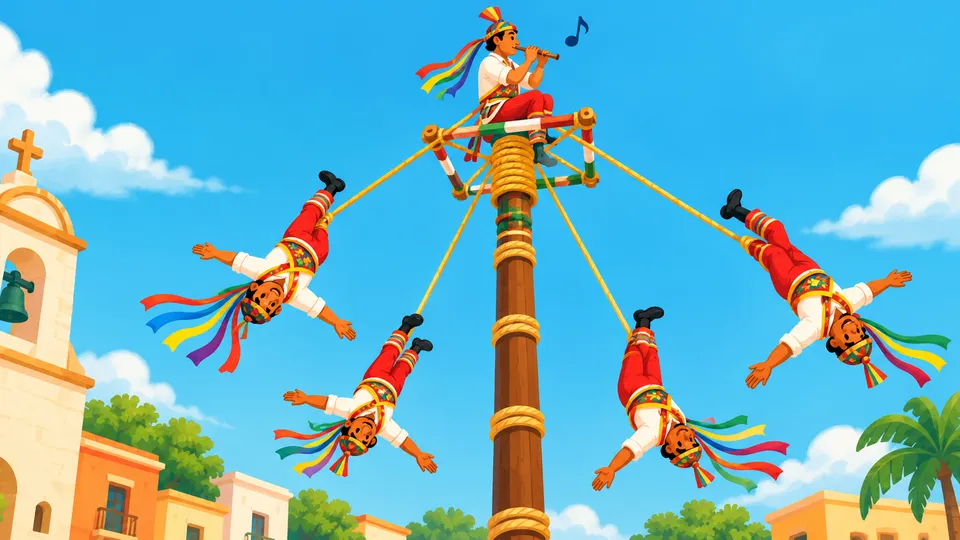
The Voladores de Papantla, or Papantla Flyers, perform one of Mexico's most remarkable traditional ceremonies. Four performers descend from a tall pole, suspended by ropes, while a fifth plays music high above them.
But this isn't simply an acrobatic performance. It's an Indigenous ritual deeply connected to nature, spirituality and the cycles of life.
The tradition is especially associated with the Totonac people of Veracruz and was recognized by UNESCO as Intangible Cultural Heritage of Humanity in 2009.
In Playa del Carmen, the Voladores have historically performed at Parque Fundadores, near Portal Maya and the beach. There is no confirmed public performance schedule, so seeing them isn't guaranteed.
What Happens During the Ceremony?
Five performers take part in the traditional ritual.
Four climb a tall pole and prepare their ropes near the top. The fifth performer, called the caporal, remains above them on a small platform, playing a flute and a small drum.
After the musical invocation, the four flyers begin their descent.
Suspended by ropes, they rotate around the pole, gradually moving toward the ground as the ropes unwind. Their movements resemble birds circling through the air.
The ceremony requires coordination, training and considerable courage. What may appear to be a spectacular aerial performance is also a deeply meaningful cultural tradition.
What Does the Ceremony Symbolize?
The Voladores ritual reflects a traditional understanding of the relationship between humanity, nature and the spiritual world. Its symbolism includes:
- The four directions
- The four descending flyers are associated with the cardinal directions.
- The music
- The caporal's flute and drum honor the sun, the four winds and the cardinal directions.
- The descent
- The circling movement evokes flight and is associated with the natural and spiritual worlds.
- Fertility and prosperity
- The ceremony traditionally expresses hopes for harmony, renewal and abundance.
Why 52?
One commonly described interpretation involves 13 rotations by each of the four flyers, creating a total of 52. This number is associated with the 52-year calendar cycle in Mesoamerican traditions.
The symbolism and ceremonial details can vary among communities.
Where Did the Voladores Tradition Begin?
The ceremony is most closely associated with the Totonac people of eastern Mexico, particularly the Papantla region of Veracruz. However, versions of the ritual are practiced by several Indigenous communities in Mexico and Central America.
Traditionally, the ceremony involved much more than the descent itself. Preparing and raising the pole could also involve prayers, offerings and rituals showing respect for the natural world.
Although visitors often encounter the Voladores in public squares and tourist destinations today, the tradition has a much deeper cultural and spiritual significance.
UNESCO added the ritual ceremony of the Voladores to its Representative List of the Intangible Cultural Heritage of Humanity in 2009, recognizing its importance to the communities that preserve it.
Where Can You See the Voladores in Playa del Carmen?
The Voladores have historically performed at Parque Fundadores, near the Portal Maya sculpture and the beachfront. Look for the tall ceremonial pole in the park area.
However, there are two important things to know:
There is no verified public schedule. Performances have historically taken place at the park, but current days and times have not been confirmed.
The pole's exact current position is unverified. Local reporting documented requests to relocate it within Parque Fundadores because of safety and operational concerns. In December 2024, municipal officials approved a relocation proposal. Reporting in June 2025 indicated that the group was still seeking a more suitable location.
For now, the best advice is to visit Parque Fundadores as part of exploring the beachfront and treat a Voladores performance as a wonderful possibility rather than a scheduled attraction.
Is It Free to Watch?
Watching the Voladores has traditionally been free, with voluntary tips welcomed by the performers.
If you enjoy the ceremony, consider leaving a tip as a gesture of appreciation and support for the people keeping the tradition alive.
There is no verified fixed admission price or required tip.
Tips for Watching Respectfully
If you encounter a performance:
- Give the performers plenty of room, especially around the landing area.
- Never touch the pole, ropes or other equipment.
- Avoid walking underneath the performers.
- Be considerate when taking photographs or recording video.
- Remember that the ceremony represents a living cultural tradition, not simply entertainment.
Are These the Same Performers as the Dancers at Portal Maya?
No. Visitors to Parque Fundadores may also see groups performing traditional or pre-Hispanic-inspired dances near the Portal Maya sculpture. Some of these groups perform Azteca-Chichimeca dances, often accompanied by drums and elaborate costumes.
The Voladores ceremony is a distinct tradition, particularly associated with the Totonac people of Veracruz.
Both offer opportunities to learn about Mexico's cultural heritage, but they should not be described as the same ceremony.
Useful Spanish: The Voladores
Tap the speaker next to a phrase to hear it.
- Voladores de Papantlaboh-lah-DOH-rehs deh pah-PAHN-tlahVoladores de Papantla (Papantla Flyers, at Parque Fundadores)
- ¿A qué hora se presentan los Voladores?ah keh OH-rah seh preh-SEHN-tahn lohs boh-lah-DOH-rehsWhat time do the Voladores perform?
- ¿Hay presentación hoy?eye preh-sehn-tah-SYOHN oyIs there a performance today?
- ¿Dónde está el palo de los Voladores?DOHN-deh eh-STAH ehl PAH-loh deh lohs boh-lah-DOH-rehsWhere is the Voladores pole?
- ¿Podemos tomar fotos?poh-DEH-mohs toh-MAHR FOH-tohsMay we take photos?
Find it. Hear it. Show it. Explore more real-life phrases in Ask Playa's Useful Spanish feature, including Mexican Spanish pronunciation and full-screen phrase display.
 Frequently Asked Questions
What are the Voladores de Papantla?
A traditional Indigenous ceremony, especially associated with the Totonac people of Veracruz, in which four flyers descend from a tall pole on ropes while a fifth performer, the caporal, plays flute and drum at the top. UNESCO recognized it as Intangible Cultural Heritage in 2009.
Where can I see the Voladores in Playa del Carmen?
They have historically performed at Parque Fundadores, near Portal Maya and the beach. There is no confirmed public schedule, and the pole's exact current position is unverified, so a performance isn't guaranteed.
What time do the Voladores perform?
There is no verified public schedule. Treat a performance as a possibility when you visit Parque Fundadores rather than a scheduled attraction.
Is it free to watch the Voladores?
Watching has traditionally been free, and voluntary tips are welcomed by the performers. There is no verified admission price or required tip.
What does the ceremony symbolize?
The four flyers are associated with the cardinal directions, the caporal's music honors the sun, the four winds and the directions, and the ceremony traditionally expresses hopes for fertility, renewal and abundance. Details can vary among communities.
Are the Voladores the same as the dancers at Portal Maya?
No. Groups near Portal Maya often perform Azteca-Chichimeca dances. The Voladores ceremony is a distinct tradition, particularly associated with the Totonac people of Veracruz.
 Sources
- UNESCO: Ritual ceremony of the Voladores (Representative List, 2009)
- INAH, Instituto Nacional de Antropología e Historia: La ceremonia ritual de los Voladores
- Riviera Maya News: Papantla Flyers request relocation within Playa del Carmen park (November 2024)
- Quadratín Quintana Roo: Reubican a Voladores de Papantla en Parque Fundadores (December 2024)
- Saber Político: Voladores de Papantla propose moving their pole in Parque Fundadores (June 2025)
- Por Esto: Traditional dancers at Portal Maya (January 2023)

Was This Helpful?